Women and Republican Motherhood
The pushback against the quest for equality for women under the new government, however, was swift. The courts ruled to maintain the idea of coverture, or the belief that married women had no legal existence separate from their husbands. As the concept of democracy expanded, a woman was only defined through her husband, and citizenship was defined as male.
Once this was established, the concept of Republican Motherhood, or the idea that it was the duty of women to educate their children to be future citizens, began to emerge. It was seen as a safer way for women to support the new nation without upsetting the patriarchal structure that excluded women from the public sphere.
—Virginia Freewoman in the Richmond Enquirer, October 20, 1829
Women found socially acceptable ways to express their political opinions and formed benevolent societies that would allow them to shape American society without voting rights. However, as suffrage began to extend to all White men in the Early Republic, some women resented their exclusion from political power and began to advocate for suffrage. As early as the 1820s, women wrote editorials in local papers calling for women’s suffrage.
The debate over whether women could have political rights only applied to White women. Many Indigenous societies had long histories of including women in their political structure. And while the nation extolled its values of liberty and freedom, many of the Framers enslaved men and women. Watch this video on Ona Judge to learn more.
| Keyboard Shortcut | Action |
|---|---|
| Space | Pause/Play video playback |
| Enter | Pause/Play video playback |
| m | Mute/Unmute video volume |
| Up and Down arrows | Increase and decrease volume by 10% |
| Right and Left arrows | Seek forward or backward by 5 seconds |
| 0-9 | Fast seek to x% of the video. |
| f | Enter or exit fullscreen. (Note: To exit fullscreen in flash press the Esc key. |
| c | Press c to toggle captions on or off |
BRENDA PARKER: Ona Judge was born at Mount Vernon around 1774. She was the daughter of Betty, an enslaved seamstress. Based on Judge's last name, her father may have been Andrew Judge, a white English tailor who Washington hired from 1772 to 1784.
Ona was later described as a light mulatto girl, much freckled and almost white. At age ten, she became Martha Washington's personal maid. Like her mother, Judge was skilled at sewing. Washington once referred to her as the perfect mistress of her needle. Also, like her mother, Judge and her younger sister, Delphi belonged to the Custis estate. Upon Martha Washington's death, they would pass on to her heirs.
When George Washington was elected president, 15-year-old Judge traveled to the executive residence, first in New York, then in Philadelphia. Judge continued her daily work waiting on Martha Washington, helping her bathe and dress, cleaning and mending her clothing, organizing her personal belongings and anything else her mistress wanted.
But in the bustling capital city of Philadelphia, life was dramatically different from Mount Vernon. In an effort to appease or distract from the temptation of gradual abolition laws in Philadelphia, Judge received nominal cash wages and on several occasions, money to go see a play, the circus, and the tumbling feats, [according to] Washington account books. No purchases for her gowns, shoes, stockings and bonnets.
The city's large, free black and Quaker abolitionist communities also offered the young woman new ideas, connections, and opportunities to escape. On May 20th, 1796, as the Washingtons prepared to return to Mount Vernon for the summer, Judge fled. She recalled in 1845, whilst they were packing to go up to Virginia, I was packing to go. I didn't know where.
For I knew that if I went back to Virginia, I should never get my liberty. I had friends among the colored people of Philadelphia. My things carried there beforehand and left Washington's house while they were eating dinner. Two days later, an advertisement was placed in the Philadelphia Gazette and the Universal Daily Advertiser announcing that she had absconded from the president's house and offered a $10 reward for her capture.
After leaving the Washington's household, Judge secured passage on the Nancy, a ship bound for Portsmouth, New Hampshire. Even in New Hampshire, Judge was not safe. Just a few months after arriving, she was recognized on the street by a friend of Martha Washington's granddaughter. Where do the escapees whereabouts reach the Washington? Who enlisted the help of Joseph Whipple, a customs collector. He found Judge and tried to convince her to return. Judge replied that she would readily return, but only if the Washingtons promise to free her after their deaths.
Otherwise, she said, she should rather suffer death than to return to slavery and liable to be sold or given to any other person.
When Washington learned of judge's request, he was furious. Washington told Whipple to keep trying, but Judge continued to refuse. In 1797, Judge married Jack Staines, a free black sailor. The couple had three children, Eliza, Will, and Nancy.
Washington would try again to recapture Judge. In August of 1799, and again she would not return to slavery. After Washington's death in December of 1799, Judge said, "The family never troubled me
anymore." She nevertheless remained a fugitive. The Custis estate could legally recapture her and her children at any time. In an interview later in life, Judge revealed that she had two reasons for running away.
First, she wanted to be free. And second, she had overheard that she would soon be given to Martha Washington's eldest granddaughter, Eliza Parke Custis Law, who was known to have a fierce temper. Judge was determined, she recalled, never to be her slave. By the 1840s, legally, Judge was considered a pauper and received support from Rockingham County. Her husband and three children had predeceased her. One interviewer asked if she was sorry she left the Washingtons, and Judge responded, "No. I am free and have, I trust, been made a child of God by the means."
TAKE NOTES
In the activity below, you will examine the paintings to answer the questions.
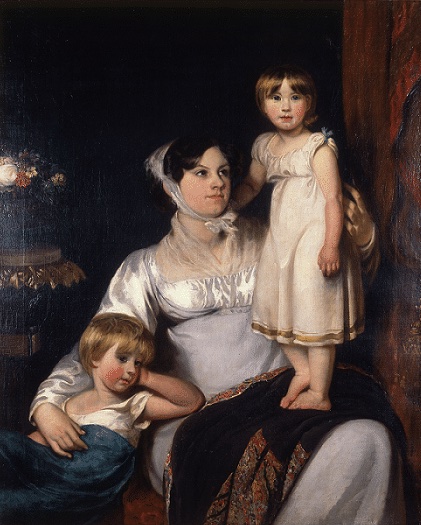
An 1818 painting of a mother and her children.
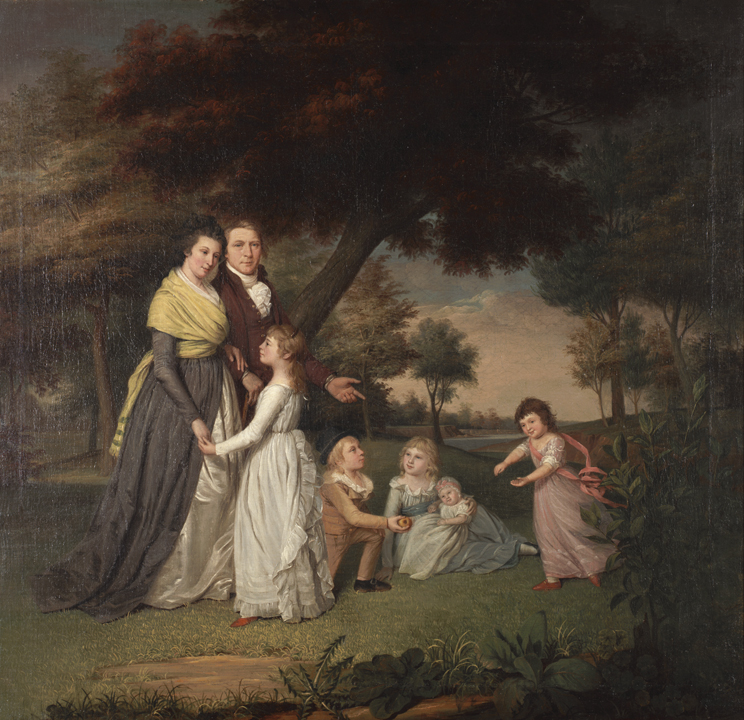
A 1795 painting of the artist, James Peale, Sr., and his family.

