Establishing Virtue
When Thomas Jefferson wrote in the Declaration of Independence that “all men are created equal,” it set the stage for an unprecedented way to explore freedom. Traditionally, Great Britain and its colonies had structured government and society on submission to authority—to a monarch, a husband, a parent, an enslaver, which created an inherently unequal society. While Jefferson’s Declaration of Independence was intended for a sovereign nation, it opened local and public debates over the meaning of freedom, liberty, and revolution. As a result of the Declaration of Independence, the idea that all people have access to equality as well as fundamental rights—such as free speech, freedom of religion, and due process of law—became openly debated in the public sphere. And while many Americans agreed with this idea, most found that these ideas were more acceptable in the abstract than in practice.
As they began to envision the possibilities of a new nation, the Framers deeply considered how they might support the character development of American citizens. These leaders hoped to instill virtue, or the ability to sacrifice self-interest for the public good, within the character of the country, and specifically through the creation of public schools. The hope was that schools would instruct young minds on the “principles of freedom” and encourage participation in the public sphere so they would be prepared to elect their representatives. The Framers believed that an electorate had to be knowledgeable in order for the nation to survive.
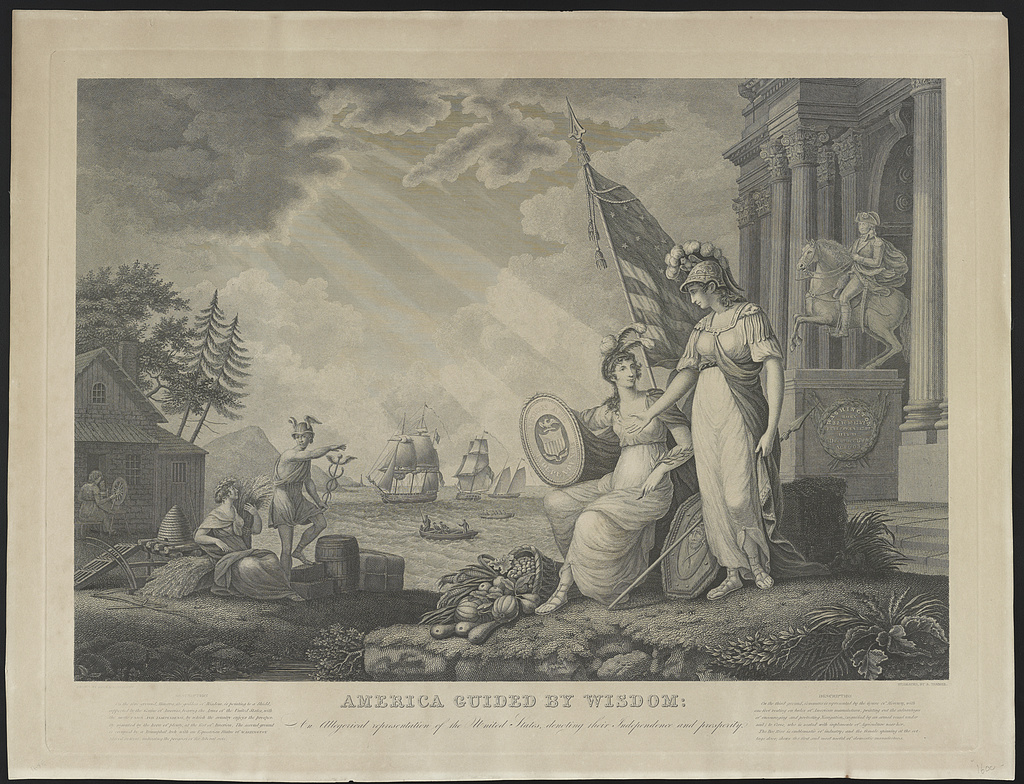
An 1815 print of a drawing by John J. Bartlett, titled “America Guided by Wisdom: An Allegorical Representation of the United States Depicting Their Independence and Prosperity.”
—James Madison, The Federalist Papers, 1787

A 1940 painting of the signing of the U.S Constitution.
In the 1700s, the concept of “democracy” had multiple definitions. The ancient Greek philosopher Aristotle defined democracy as a “system in which the entire people governed directly.” Known as “direct democracy,” it is considered a form of government in which policies and laws are decided by a majority of all those eligible to vote rather than by a body of elected representatives. For example, in ancient Athens, 6,000 citizens were required for a quorum.
The Framers feared direct democracy and saw it akin to mob rule. But the term democracy began to take on wider meaning to express equality. New debates over universal male suffrage, religious toleration, and abolitionism circulated not only among the Framers, but among ordinary people, such as farmers and laborers.
TAKE NOTES
Using what you’ve learned so far, answer the question below.
How did the concept of democracy evolve in the 1700s?

