To the Rhino Barn
Exit out the door and turn right, you will see two bronze sculptures along the path. The “Battling Rhinos” and the “Ancient Tortoise”, commissioned by the Theodore and Claire Hubbard Foundation, were created by artist Gary Staab. These statues now grace the landscape and bring to life the fossils that lay partially excavated in the Hubbard Rhino Barn.
Stop at the Bronze Sculptures and view information about the creation of the sculptures. View the work in 3D as part of the virtual tour and the photos on this page.
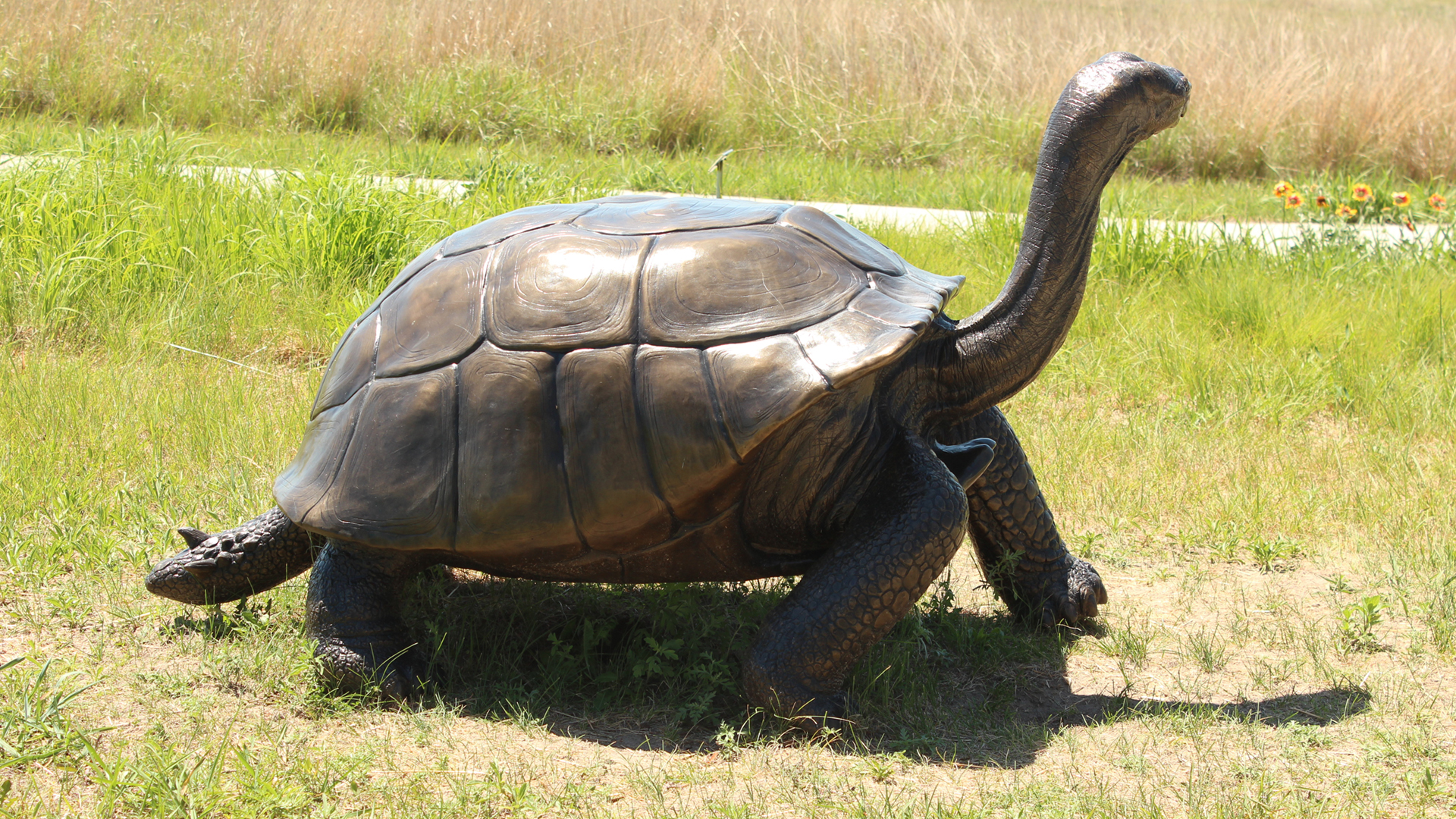 Bronze sculpture "Ancient Tortoise" by Artist Gary Staab
Giant Tortoise (Hesperotestudo)
Shells and big bones of giant land turtles are extremely abundant in the layers of sandstone above and below the volcanic ash bed but only one specimen has been found in the ash bed. This species was buried about 3 feet above the mass of rhino, camel, and horse skeletons at the bottom of the ash bed. Perhaps because turtles breathe very slowly, he apparently survived much longer (possibly a month or more) than other animals at the waterhole.
Characteristics:
- The largest Ashfall specimen had a shell of 4 feet (1.2 meters) long.
- Like the giant tortoises of today this animal was a strict vegetarian, surviving on low-growing plants.
- Tortoises cannot survive more than a few hours in freezing temps.
- Hespero means western and Testudo is the Greek name for the common land tortoise of the Old World.
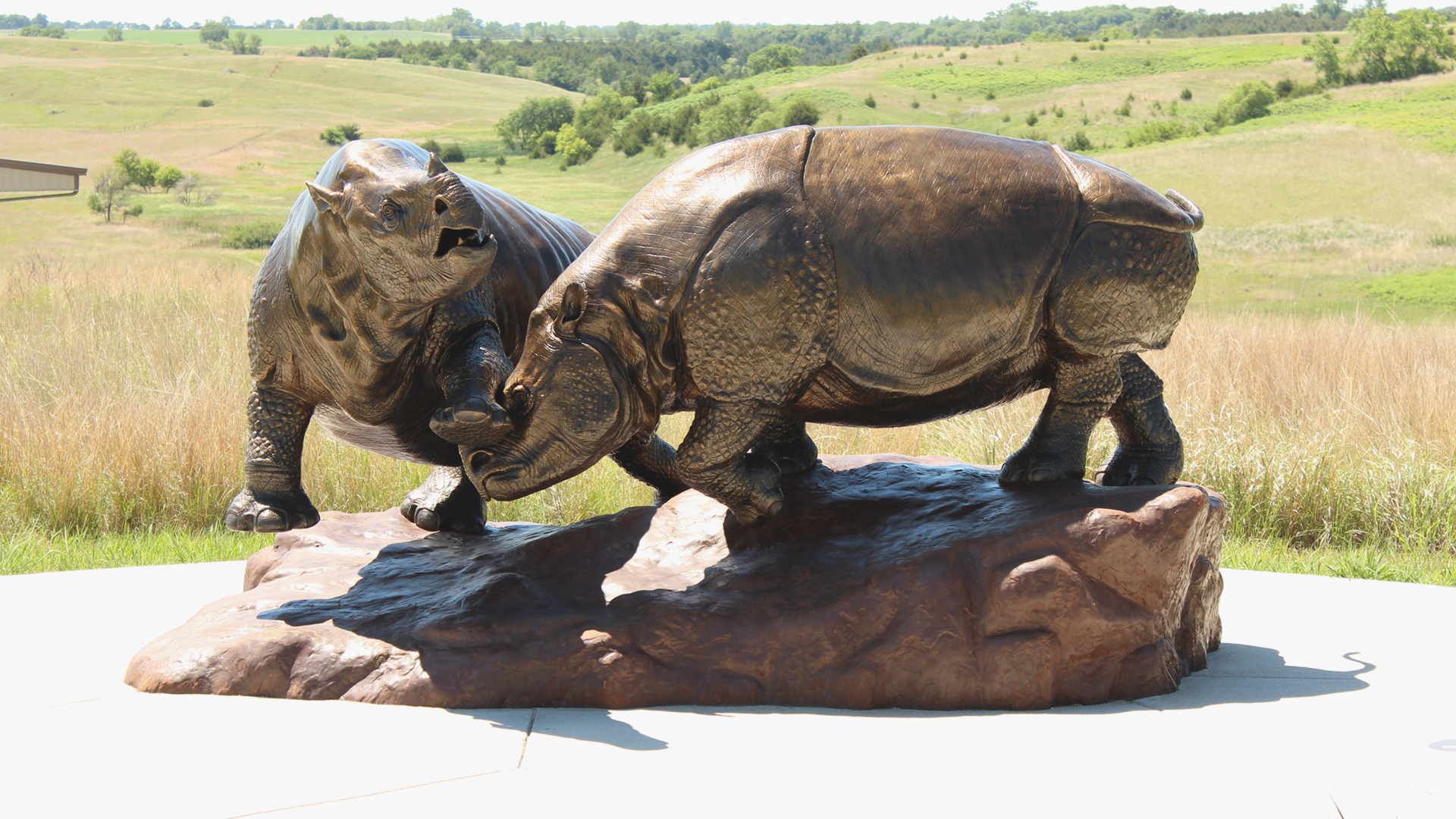 Bronze sculpture "Battling Rhinos" by Artist Gary Staab
Barrel-bodied Rhino (Teleoceras major)
The most abundant large animal discovered in the volcanic ash bed is an extinct rhinoceros with a body shape similar to today’s hippopotamus. By studying the age and sex of more than 100 skeletons from Ashfall, paleontologists concluded that Teleoceras males (with large tusks) may have to defend “harems” of females (with small tusks) and their calves. Young adult male skeletons are remarkably rare in the Ashford, suggesting that “bachelor males' ' may have been excluded from the breeding herd and forced to live somewhere else.
Characteristics:
- Stood three and a half feet tall at the shoulder.
- Barrel-chested, with a body that measured 10 feet around the belly.
- The most abundant large animal discovered at Ashfall.
- Both males and females had a single small nasal horn.
- Teleoceras means “perfect horn.”

