The Haudenosaunee Confederacy
—Benjamin Franklin, 1751
The oldest functioning democracy in North America, the Haudenosaunee was originally composed of five nations forming a confederacy. Made up of the Mohawks, Oneidas, Onondagas, Cayugas, and Senecas, the Haudenosaunee Confederacy was intended as a way to unite the nations and create a peaceful means of decision making, with a common goal to live in harmony. Later, the alliance was expanded to include six nations.
Watch the video to learn more.
| Keyboard Shortcut | Action |
|---|---|
| Space | Pause/Play video playback |
| Enter | Pause/Play video playback |
| m | Mute/Unmute video volume |
| Up and Down arrows | Increase and decrease volume by 10% |
| Right and Left arrows | Seek forward or backward by 5 seconds |
| 0-9 | Fast seek to x% of the video. |
| f | Enter or exit fullscreen. (Note: To exit fullscreen in flash press the Esc key. |
| c | Press c to toggle captions on or off |
NARRATOR: We're often taught that it was the ancient Greeks who invented our democracy. What they forget to mention is the group of Native Americans who helped show us the way.
The Iroquois Confederacy inhabited Northern and Western New York State. They called themselves "Haudenosaunee" meaning "People of the Longhouse."
The Confederacy was founded by the Great Peacemaker, Deganawidah, to put a stop to internal feuds and become a united front against outside threats.
Each tribe had a voice and while many issues were addressed at a local level, major decisions like defense were made as a whole.
They even had a Constitution known as the Great Law of Peace. For the framers of the US constitution - they were an inspiration, a real-life example of how democracy could and should work.
But the Founding Fathers didn't just stumble upon the idea from the Iroquois Confederacy. The information was shared by the members of the Iroquois themselves. They attended the Albany Congress in 1754, when Benjamin Franklin, inspired by the Iroquois Confederacy, submitted what became known as the Albany Plan of Union. It advocated for the union of the colonies to improve security and defense from foreign powers. Although it was never adopted, its influence remained.
In 1776 the Iroquois were invited to address the Continental Congress in Philadelphia and shortly after, the Founding Fathers drafted a Constitution echoing the Great Law of Peace.
James Monroe even personally requested the company of the Oneida Chief for some guidance.
In 1988, the US Senate published a resolution paying tribute to the Iroquois Confederacy. It acknowledged its influence on the democratic principles, which underpin our government today.
Why do you think students in the U.S. are taught that our form of democracy stems from Greece and not from Native Americans?
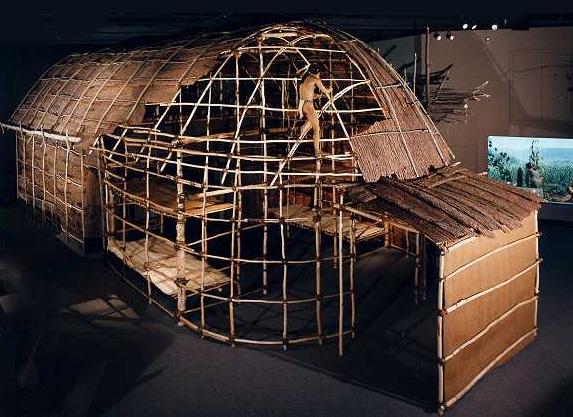
A reconstruction of a Mohawk longhouse at the New York State Museum.
Long before the Constitution was written, the framers forged close ties with the Haudenosaunee. In the 1730s and 1740s, English cooperation with the Haudenosaunee was essential to defend English territory against France in North America. Benjamin Franklin, a printer from Pennsylvania, became deeply involved in treaty councils with the Haudenosaunee. During one such council, Canassatego, the Onondaga Chief, advocated for the 13 colonies to form a union, telling Franklin about the challenges the Haudenosaunee faced in dealing with individual colonies. Franklin took his idea seriously.
Inspired by the Haudenosaunee’s confederacy model, Franklin created the Albany Plan of Union in 1754 with the hope of uniting the colonies under a more centralized government. While Franklin’s plan failed to gain support from colonial governments, the Haudenosaunee had left an impression.
Take Notes
Fill out the Haudenosaunee Confederacy section of the chart below.

