Constituciones de los Estados
Las constituciones estatales ofrecieron otra base para que los forjadores incorporaran principios familiares sobre la gobernanza. Si bien la mayoría de las constituciones estatales siguen el modelo de la Constitución de los Estados Unidos, cuatro colonias tenían constituciones escritas antes de la Declaración de Independencia. Los Estados incorporaron principios tan conocidos como la soberanía popular, la separación de poderes, una legislatura bicameral, el establecimiento de un jefe ejecutivo (gobernador), un sistema judicial, y la implementación de controles y equilibrios. Si bien había muchas similitudes entre las constituciones estatales, la Constitución de Massachusetts sirvió como modelo para la Constitución de los Estados Unidos en términos de su estructura y sustancia. A diferencia de otras constituciones que solo enumeraban disposiciones, la versión de Massachusetts tenía capítulos, secciones y artículos.
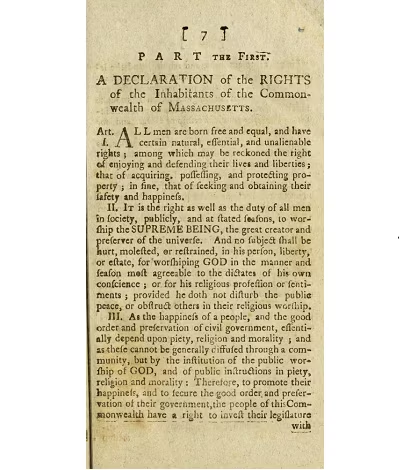
Los primeros artículos de la Constitución de Massachusetts de 1780, escritos principalmente por John Adams.
Part the First.
A Declaration of the Rights of the Inhabitants of the Commonwealth of Massachusetts.
Article 1. All men are born free and equal, and have certain natural, essential, and unalienable rights; among which may be reckoned the right of enjoying and defending their lives and liberties; that of acquiring, possessing, and protecting property; in fine, that of seeking and obtaining their safety and happiness.
II: It is the right as well as the duty of all men in society, publicly, and at stated seasons, to worship the SUPREME BEING, the great creator and preserver of the universe. And no subject shall be hurt, molested, or restrained, in his person, liberty, or estate, for worshiping GOD in the manner and season most agreeable to the dictates of his own conscience; or for his religious profession or sentiments; provided he doth not disturb the public peace, or obstruct others in their religious worship.
III. As the happiness of a people, and the good order and preservation of civil government, essentially depend upon piety, religion and morality; and as these cannot be generally diffused through a community, but by the institution of the public worship of GOD, and of public instructions in piety, religion and morality: Therefore, to promote their happiness, and to secure the good order and preservation of their government, the people of this Commonwealth have a right to invest their legislature with...
Toma notas
Rellena la sección de Constituciones de los Estados de la tabla a continuación.

