The Montgomery Bus Boycott
One of the first major successes of the 1950s civil rights movement was initiated by activist Rosa Parks. In 1955, city buses throughout the South were racially segregated. On crowded buses, Black people were required to give up their seats to Whites and move to the back of the bus. In many cases, Black riders had to pay their fare to the driver and then exit the bus and reenter through the back door. Rosa Parks rode the bus every day. On December 1, 1955, Parks was returning home from work on a crowded bus when the driver ordered her to give up her seat to a White man. When Parks refused, she was arrested for violating a city ordinance that enforced segregation on city buses.
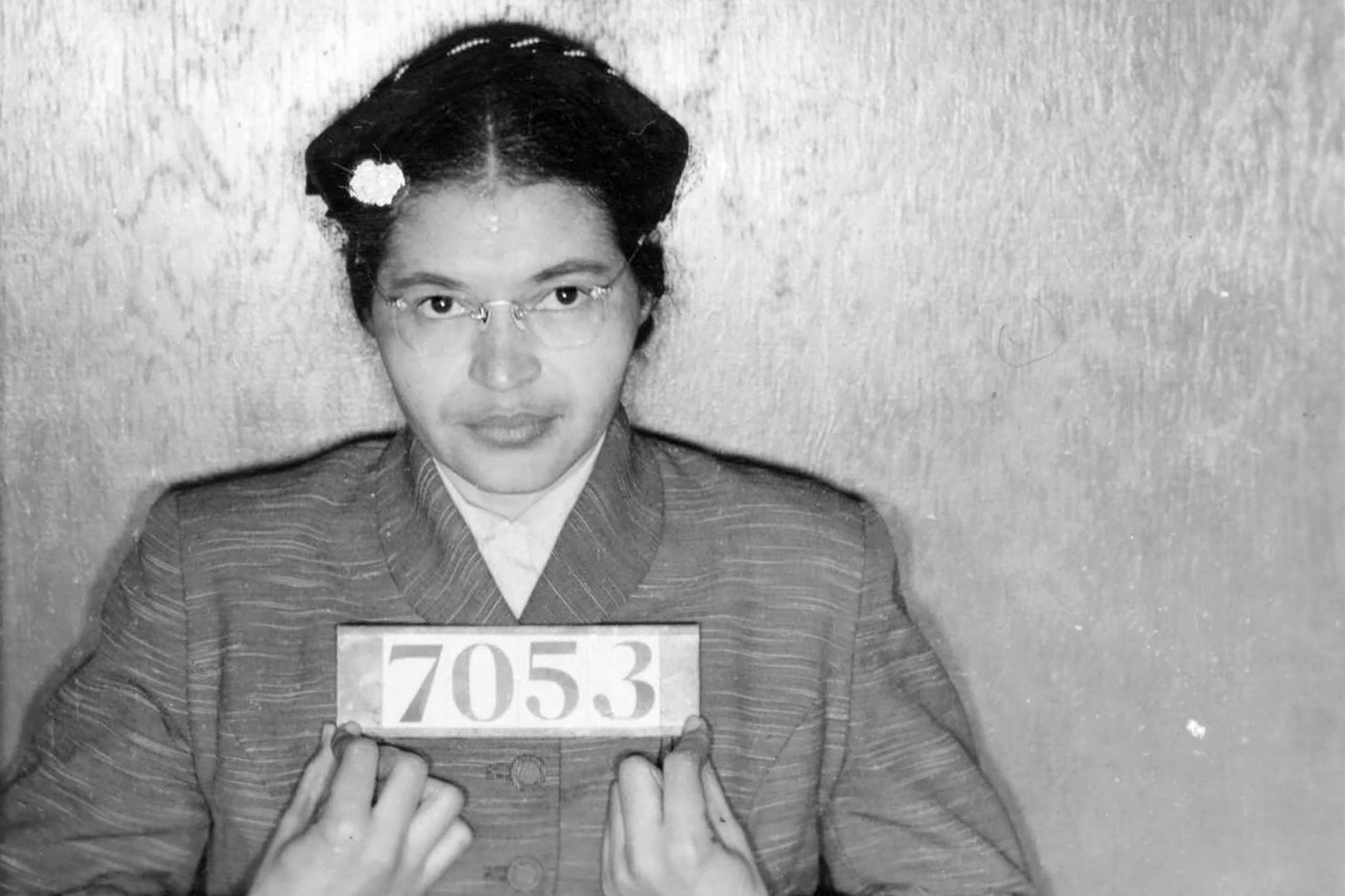
Police photograph of Rosa Parks following her arrest, 1955.
Parks’s refusal spawned a citywide bus boycott by the Black citizens of Montgomery. The Women's Political Council organized a one-day boycott. When the city didn't respond, the Montgomery Improvement Association, led by a charismatic young minister named Martin Luther King, Jr., was formed to continue the boycott. NAACP leader E. D. Nixon, for whom Parks worked, used her arrest to advance the issue of segregated buses in court. Months before Parks’s arrest, four other women had been arrested for refusing to give up their seats on a bus. Their case, Browder v. Gayle, eventually reached the U.S. Supreme Court. The boycott lasted for 381 days. It ended on December 21, 1956, after the Supreme Court ruled in Browder v. Gayle that segregated seating on city buses was unconstitutional.
In 1957, the Montgomery Improvement Association evolved into the Southern Christian Leadership Conference (SCLC), a civil rights organization founded by Dr. Martin Luther King, Jr., Bayard Rustin, Ralph Abernathy, and others to better coordinate civil rights protests across the South.
Take Notes

