Simplifying Fractions
Fractions are easier to understand when they are written with smaller numbers. Simplifying, also called reducing to lowest terms, means finding an equivalent fraction with the smallest possible numerator and denominator. The numerator is the top number in the fraction and the denominator is the bottom number. If they can both be divided by the same number, they can be reduced. For example, at a busy restaurant, Robert knew that \(\frac{12}{24}\)of the customers customers used a credit card, but he reported the fraction to his manager as \(\frac{1}{2}\). Robert simplified the fraction \(\frac{12}{24}\) to \(\frac{1}{2}\) by dividing the top and bottom numbers by 6.
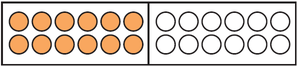
\(\frac{12}{24}\) and \(\frac{1}{2}\) are equivalent fractions because they have the same value. Of the 24 circles shown here, 12 are shaded. As you can see, the shaded portion is \(\frac{1}{2}\) of the total.
To reduce a larger fraction to lowest terms:
Step 1: Divide both the numerator and the denominator by the same number.
\(\large \frac{12}{24} \div \frac{12}{12} = \color{firebrick}{\frac{1}{2}}\)
Step 2: Will another number divide evenly into both terms in the new fraction? If the answer is yes, repeat step 1. If not, the fraction is in lowest terms.
Other Examples:
\(\large \frac{4}{6} \div \frac{2}{2} = \color{firebrick}{\frac{2}{3}}\)
\(\large \frac{24}{42}\div \frac{2}{2} =\color{firebrick}{\frac{12}{21}}\div \frac{3}{3} =\color{firebrick}{\frac{4}{7}}\)
