Introduction
The Declaration of Independence, adopted by the Continental Congress on July 4, 1776, announced Americans’ decision to separate from Great Britain and to create a new nation. While in the decades following its creation the Declaration of Independence was viewed mainly as the document that proclaimed America’s formal break from England, its eventual use by leaders, movements, and organizations resulted in its acquiring what historian Pauline Maier has referred to as a sacred status.
The ideas that “all men are created equal, that they are endowed by their Creator with certain unalienable Rights, that among these are Life, Liberty and the pursuit of Happiness.--That to secure these rights, Governments are instituted among Men, deriving their just powers from the consent of the governed” now stand as a statement of the values that bind Americans as a people and reflect the enduring ideals that we strive to achieve.
In this interactive lesson, you will learn about the 1848 Seneca Falls Convention, the first women's rights convention in the United States, and analyze its Declaration of Sentiments, deliberately modeled on the Declaration of Independence and designed to connect its cause to that of 1776. At the end of the interactive lesson, you will be asked to respond to the essential question.
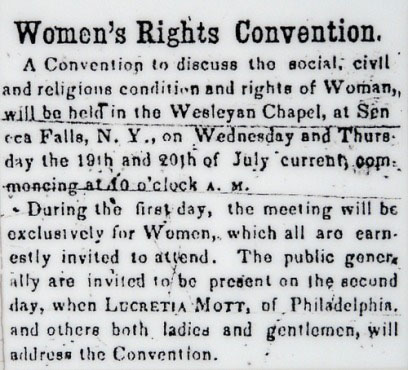
Newspaper article announcing the women’s rights convention in Seneca Falls, New York, on July 19, 1848.
Essential Question
How did the Declaration of Independence inspire the women’s rights movement in the United States and influence the Declaration of Sentiments?

