Introduction
The Bill of Rights was added to the U.S. Constitution on December 15, 1791. These first 10 amendments were written to address Anti-Federalists’ concerns about a too-powerful federal government that could limit or abolish individual liberties. When James Madison spoke to the first Congress about adding a bill of rights, he proposed nearly 20 amendments; through discussion and debate, 10 were selected by House and Senate Conference Committees.
| Keyboard Shortcut | Action |
|---|---|
| Space | Pause/Play video playback |
| Enter | Pause/Play video playback |
| m | Mute/Unmute video volume |
| Up and Down arrows | Increase and decrease volume by 10% |
| Right and Left arrows | Seek forward or backward by 5 seconds |
| 0-9 | Fast seek to x% of the video. |
| f | Enter or exit fullscreen. (Note: To exit fullscreen in flash press the Esc key. |
| c | Press c to toggle captions on or off |
NARRATOR 1: The first ten amendments to the United States Constitution are known collectively as the Bill of Rights. England and the American colonies had a long tradition of listing out rights considered essential as a means of protecting them from government overreach. The purpose of a Bill of Rights was twofold: to protect the rights of individuals and to limit government power.
NARRATOR 2: So, what were the individual rights protected in the Bill of Rights, and how did they limit the power of the government? This is the story of the origins and purposes of the Bill of Rights.
C-SPAN FOOTAGE: One Minister.
NARRATOR 1: Several declarations of rights throughout English history influenced the American Founders. The Magna Carta of 1215, the English Petition of Right of 1628, and the English Bill of Rights in 1689 protected basic liberties such as trial by jury, no taxation without consent, free elections, and no cruel and unusual punishment. These documents also limited the power of a monarchical government.
During the 1760s and 70s, the American colonists followed this model and created their own declarations that asserted an understanding of their rights as Englishmen to hold the British government accountable. For example, both the Stamp Act Congress of 1765 and the First Continental Congress issued a Declaration of Rights, and famously the Declaration of Independence stated that the British government was in violation of the rights of the colonists.
After independence, most states created their own bills of rights. However, the national government organized under the Articles of Confederation did not contain a formal Bill of Rights. When delegates met in 1787 to produce a strengthened but still limited national government, the topic of a federal Bill of Rights was raised once again.
George Mason proposed to the Constitutional Convention that it consider adding a Bill of Rights, stating that the document was insufficient without one. Mason wrote, “There is no declaration of rights in the proposed Constitution and the laws of the General Government being paramount to the laws and constitution of the several states. The declarations of rights in the separate states are no security.” His motion was unanimously rejected.
NARRATOR 2: As the Constitution went through the ratification process. The idea of a Bill of Rights was raised again and became central to the debate.
Those who opposed the new constitution were called Anti-Federalists and believed a Bill of Rights was necessary to protect individual liberties. Many Federalists, such as Alexander Hamilton, James Madison, and James Wilson, argued against it as they felt these rights were already protected by the Constitution, and listing any rights might imply that other unlisted rights didn’t exist. It was also argued there were unnecessary in a system of popular government, a point of view summarized by Hamilton in Federalist 84.
NARRATOR 1: Eventually, a compromise was reached, and the Federalists who supported the Constitution then pledged that a Bill of Rights would be added during the first Congress after the Constitution was ratified and became the law of the land.
In this interactive lesson, you will learn what rights and protections are in the first 10 amendments and what the historical context was for each amendment. At the end of the lesson, you will use what you have learned to answer the essential question.
Essential Question
What essential liberties are protected by the first 10 amendments, and why did the Framers prioritize these rights?
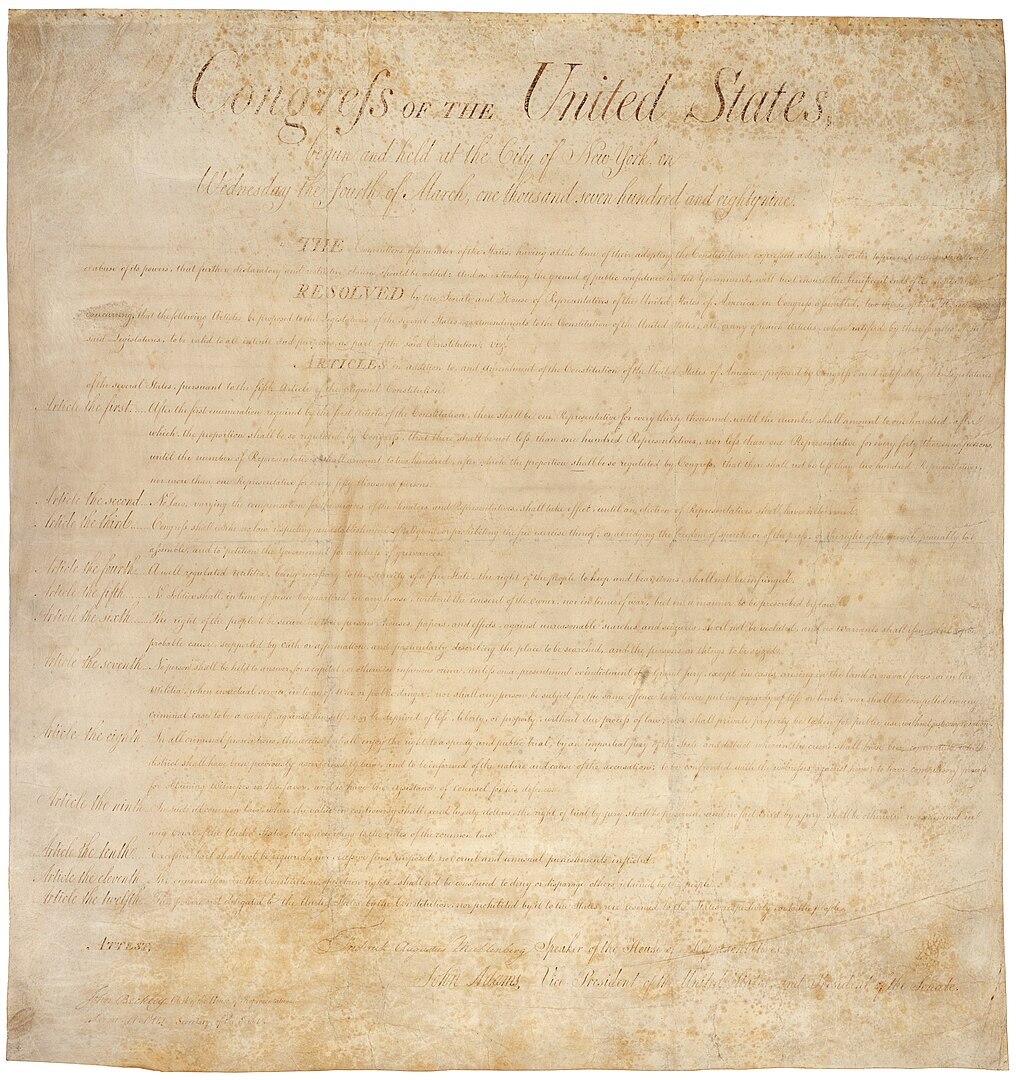
The Bill of Rights.

